
Advanced Sliding Materials for Pumps and Compressors: Improving Wear Resistance and Operational Reliability
Pumps and compressors are essential components in modern industrial infrastructure. They are widely used in oil and gas processing, chemical production, power generation, water treatment, manufacturing, refrigeration, and many other industrial applications.
These machines often operate under demanding conditions involving pressure, temperature fluctuations, continuous movement, fluid exposure, and mechanical loads. Their performance depends not only on the overall equipment design but also on the materials used in critical moving and sliding components.
Sliding materials play an important role in reducing friction, controlling wear, maintaining dimensional stability, and supporting reliable equipment operation. Selecting the appropriate material can help extend component service life, reduce maintenance requirements, and improve the overall efficiency of industrial machinery.
At VOCARBON, we focus on carbon-based materials, carbon brushes, carbon brush holders, slip ring components, and customized carbon and graphite products. Our interest in industrial sliding applications is based on the engineering characteristics of carbon and graphite materials and their suitability for selected friction and wear-related applications.
1. Why Sliding Materials Matter in Pumps and Compressors
Pumps and compressors contain components that move relative to one another during operation.
Depending on the machine design, these components may include bearings, bushings, wear rings, guide rings, shaft sleeves, mechanical seal components, and other parts exposed to friction and contact.
The interaction between moving surfaces can generate heat, wear particles, vibration, and dimensional changes.
If the materials are not properly selected, excessive wear or friction may affect equipment performance and increase the risk of premature component failure.
Appropriate sliding materials should be evaluated according to several important properties:
-
Low and stable friction under the intended operating conditions
-
Resistance to abrasive and adhesive wear
-
Dimensional stability
-
Suitable mechanical strength
-
Compatibility with the working fluid or gas
-
Temperature resistance
-
Chemical and corrosion resistance
-
Compatibility with the counterface material
-
Performance under the expected lubrication conditions
No single material provides the best performance in every application. The correct choice depends on the equipment design, operating environment, and required service life.
2. Common Sliding Applications in Industrial Pumps
Industrial pumps are designed to transfer liquids across a wide range of flow rates and pressure conditions.
Centrifugal pumps, reciprocating pumps, chemical process pumps, and other pump designs use different mechanical arrangements. Their sliding components therefore have different requirements.
Wear Rings
Wear rings are installed in selected pump designs to control internal leakage between high-pressure and low-pressure regions.
They help maintain suitable clearances between rotating and stationary components. Material selection should consider fluid compatibility, operating temperature, mechanical loading, and the potential presence of abrasive particles.
Bushings and Bearings
Bushings and bearings support shafts and other moving components.
In selected pump designs, sliding bearings or sleeve bearings are used to support rotating shafts. Their materials must provide suitable load capacity, wear resistance, and compatibility with the lubrication or process fluid.
Shaft Sleeves
Shaft sleeves protect the main shaft from wear and damage in specific locations.
They may be exposed to friction, fluid contact, and mechanical loading. Material selection depends on the pump design, operating environment, and maintenance requirements.
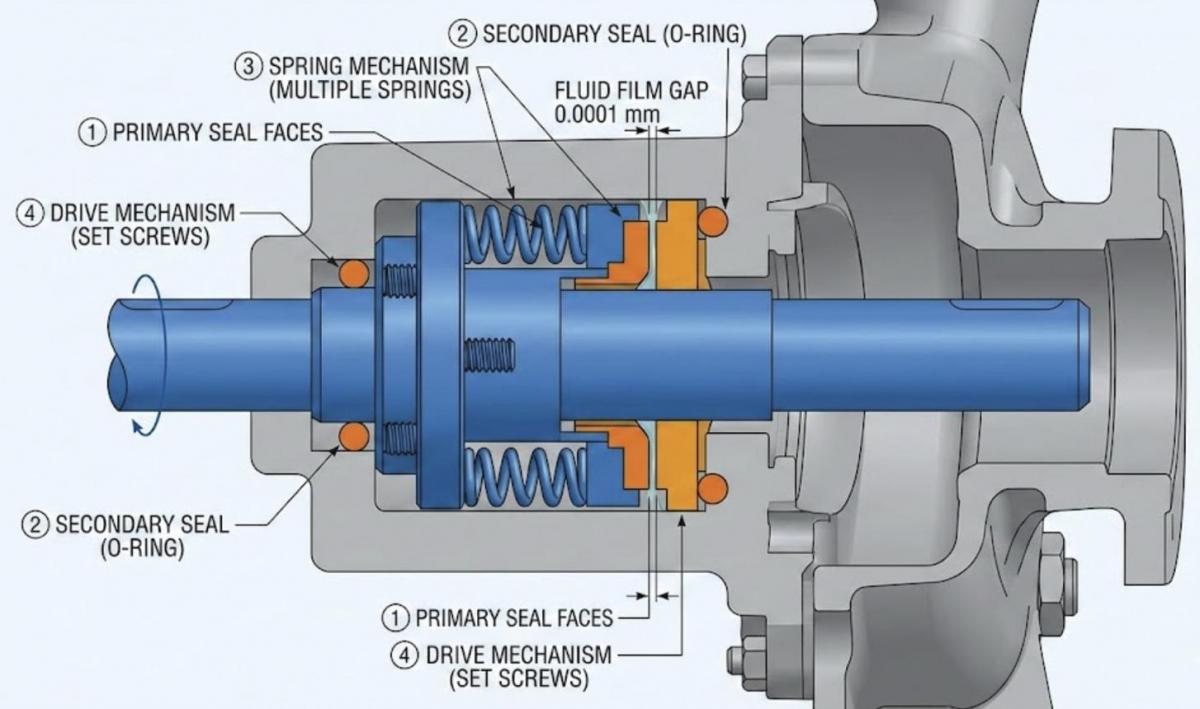
Mechanical Seal Components
Mechanical seals help prevent leakage along rotating shafts.
Certain seal designs use carbon or carbon-graphite materials as one of the sliding faces. The material must be compatible with the mating face, process fluid, temperature, pressure, and lubrication conditions.
This is an important application area for carbon-based materials, although the suitability of a specific grade must always be evaluated for the actual service conditions.
3. Sliding Materials for Industrial Compressors
Compressors are used to increase gas pressure in industrial processes, refrigeration systems, gas transportation, and energy production.
Different compressor technologies have different material requirements.
Reciprocating compressors, screw compressors, centrifugal compressors, and other designs use different combinations of bearings, seals, rings, and moving components.
Reciprocating Compressors
Reciprocating compressors use pistons moving within cylinders.
Depending on the design, piston rings, rider rings, guide rings, and sealing elements may be used to control leakage, guide movement, and reduce wear.
Non-metallic engineering materials and selected filled polymers are used in some applications where their mechanical, thermal, and chemical characteristics are suitable.
Carbon-based materials may also be relevant to specific compressor components, but their use depends on the equipment design and application requirements.
Screw Compressors
Screw compressors rely on rotating screw elements to compress gas.
Their operating performance depends on precise clearances, rotor synchronization, bearings, sealing arrangements, and suitable lubrication.
Sliding material requirements vary according to whether the compressor is oil-injected, oil-free, or designed for a specialized industrial process.
Centrifugal Compressors
Centrifugal compressors operate using high-speed rotating impellers.
Their critical components include bearings, seals, shaft systems, and other precision mechanical assemblies.
Many centrifugal compressor designs rely on fluid-film bearings or specialized mechanical systems rather than conventional dry-sliding components.
Consequently, material selection must be based on the actual compressor architecture rather than assuming that the same sliding material can be used across all compressor types.
4. Carbon and Graphite Materials in Sliding Applications
Carbon and graphite materials have several properties that make them useful in selected industrial friction and sliding applications.
Depending on the grade and manufacturing process, they can offer:
-
Self-lubricating characteristics
-
Relatively low friction in suitable contact systems
-
Good thermal stability
-
Chemical resistance in selected environments
-
Dimensional flexibility through material formulation
-
Compatibility with certain sealing and bearing applications
These properties make carbon and graphite materials relevant to selected mechanical seals, bearing systems, guide components, and other specialized industrial applications.
However, carbon and graphite are not interchangeable with every engineering material.
Their performance depends on material composition, porosity, impregnation, strength, counterface finish, lubrication, and operating conditions.
Resin-Impregnated Carbon and Graphite
Resin impregnation can modify the porosity and properties of carbon and graphite materials.
Certain resin-impregnated grades are used in applications where chemical compatibility, sealing performance, and mechanical properties meet the requirements.
The resin system must be selected according to the working fluid and temperature.
Metal-Impregnated Carbon and Graphite
Metal impregnation can improve selected mechanical and thermal properties.
Depending on the material system, these grades may be considered for applications requiring particular strength, thermal conductivity, or wear characteristics.
Their chemical compatibility and operating limitations must be evaluated before use.
Antimony-Impregnated Carbon and Graphite
Antimony-impregnated carbon and graphite grades are used in certain industrial mechanical seal and bearing applications.
They can offer useful combinations of mechanical strength and sliding performance under suitable conditions.
However, their suitability depends on temperature, fluid chemistry, pressure, and the design of the mating surfaces.
Other Engineered Carbon Materials
Different carbon and graphite formulations can be developed for specific mechanical and electrical applications.
Material selection should be based on measurable properties and the actual operating conditions rather than general material descriptions.
5. Engineering Polymers and Other Sliding Materials
Carbon and graphite are not the only materials used in pump and compressor sliding systems.
Engineering polymers, composite materials, ceramics, and metals are also widely used.
The choice depends on the required balance between friction, wear resistance, strength, temperature capability, and chemical compatibility.
PTFE and Filled PTFE
Polytetrafluoroethylene (PTFE) is known for its low-friction characteristics and chemical resistance.
Filled PTFE compounds may be used in selected wear rings, bearings, seals, and guide components.
Fillers can modify mechanical strength, creep resistance, and wear performance.
PEEK
Polyether ether ketone (PEEK) is a high-performance engineering polymer used in demanding industrial environments.
Depending on the grade, it can provide good mechanical strength, wear resistance, and thermal performance.
Filled PEEK compounds are used in selected bearing and wear applications.
UHMW-PE
Ultra-high-molecular-weight polyethylene is used in applications where impact resistance, abrasion resistance, and low friction are important.
Its temperature and mechanical limitations must be considered when selecting it for industrial equipment.
Metallic Materials
Stainless steels, bronze alloys, and other metallic materials are used in various bearing, wear ring, shaft sleeve, and mechanical components.
They can provide mechanical strength and dimensional stability, although their friction and wear behavior depend on the contact system and lubrication.
The most suitable material is the one that satisfies the complete application requirements, not necessarily the material with the highest individual performance rating.
6. Important Factors When Selecting Sliding Materials
Choosing a sliding material for a pump or compressor requires a systematic evaluation.
The following factors are particularly important.
Operating Temperature
Temperature affects material strength, expansion, lubrication, and chemical compatibility.
The maximum continuous operating temperature and possible temperature fluctuations should be considered.
Pressure and Mechanical Loading
Sliding components may experience radial loads, axial loads, contact pressure, or pressure differences across sealing surfaces.
The material must have sufficient strength and dimensional stability for the intended loading conditions.
Working Fluid and Chemical Compatibility
Pumps and compressors may handle water, hydrocarbons, chemicals, solvents, refrigerants, gases, or mixtures containing contaminants.
Material compatibility must be checked against the actual process medium, including concentration, temperature, and exposure time.
Lubrication Conditions
Some sliding systems operate with oil or liquid lubrication, while others are designed for limited lubrication or dry running.
Material selection must reflect the intended lubrication regime.
Surface Finish and Counterface Material
The material of the mating surface and its surface finish influence friction and wear.
A suitable sliding material may perform poorly when paired with an inappropriate counterface or surface condition.
Operating Speed
Sliding velocity influences frictional heating, wear behavior, and the stability of the contact interface.
High-speed applications require particular attention to thermal management and material compatibility.
Service Life and Maintenance Requirements
The expected service interval, replacement accessibility, and cost of downtime should all be considered when evaluating material alternatives.
7. Improving Reliability Through Proper Component Design
Material selection is only one part of reliable pump and compressor operation.
Component geometry, manufacturing accuracy, installation quality, and operating conditions also play important roles.
For example, a wear ring manufactured outside the specified tolerance may create excessive leakage or insufficient clearance.
A bearing material with suitable wear characteristics may still fail if shaft alignment, lubrication, or surface finish is inadequate.
Similarly, a mechanical seal can experience premature failure when the seal faces are incorrectly matched or when the process conditions exceed the material's limitations.
A reliable engineering approach should therefore consider:
-
Correct material grade
-
Dimensional tolerances
-
Surface finish
-
Component geometry
-
Assembly compatibility
-
Lubrication and cooling
-
Operating pressure and temperature
-
Inspection and maintenance procedures
For replacement components, these factors should be evaluated against the original equipment requirements whenever possible.
8. Customized Carbon and Graphite Components
Industrial customers sometimes face difficulties sourcing replacement components for older equipment, specialized machinery, or discontinued product lines.
In such situations, customized components manufactured according to drawings or physical samples may provide a practical alternative, provided that technical compatibility can be established.
VOCARBON supports inquiries involving carbon brushes, brush holders, slip ring components, and selected customized carbon and graphite products.
For carbon-based components used in specialized mechanical applications, customers should provide sufficient technical information to determine whether the required material and manufacturing process are suitable.
Useful information includes:
-
Original part number and equipment manufacturer
-
Equipment model and application
-
Technical drawings or physical samples
-
Overall dimensions and tolerances
-
Required carbon or graphite material grade
-
Working fluid or gas
-
Operating temperature and pressure
-
Rotational or sliding speed
-
Required quantity and expected service conditions
Where the original material grade is unknown, additional application information and testing may be required before proposing an alternative.
A replacement should never be considered suitable solely because its dimensions and appearance match the original component.
9. Quality Control and Material Verification
For sliding components, quality control should focus on the properties that directly affect performance.
Depending on the product and customer specification, inspection may include:
-
Dimensional measurement
-
Density testing
-
Hardness testing
-
Electrical resistivity testing, where applicable
-
Compressive or flexural strength testing
-
Porosity evaluation
-
Visual inspection
-
Material identification
-
Surface finish inspection
Not every test is relevant to every carbon or graphite component.
The inspection plan should be established according to the material type, component function, and applicable technical requirements.
For customized replacement parts, maintaining consistency between approved samples, technical drawings, and subsequent production batches is especially important.
10. VOCARBON: Carbon-Based Solutions for Industrial Applications
VOCARBON focuses on carbon brushes, carbon brush holders, slip ring components, and customized carbon-based electrical products.
Our product direction is closely connected to industrial electrical equipment, rotating machinery, and selected applications where carbon and graphite materials are required.
We recognize that industrial customers need more than a product description. They need clear technical communication, appropriate material information, accurate dimensions, and practical replacement options.
For inquiries involving carbon and graphite components, customers are encouraged to share drawings, samples, part numbers, and operating conditions.
This information helps establish whether a particular material or customized solution is appropriate for the intended application.
Conclusion: Choosing the Right Sliding Material for Long-Term Performance
Pumps and compressors operate under a wide range of mechanical, thermal, and chemical conditions.
The sliding materials used in bearings, wear rings, bushings, sealing systems, and other moving components can influence equipment efficiency, maintenance requirements, and service life.
Carbon and graphite materials, engineering polymers, composites, ceramics, and metallic alloys each offer different advantages.
Successful material selection requires an understanding of the complete operating environment, including temperature, pressure, speed, lubrication, chemical compatibility, and mechanical loading.
VOCARBON is committed to supporting industrial customers with carbon brushes, brush holders, slip ring components, and customized carbon-based solutions based on their technical requirements.
Looking for carbon brushes or customized carbon and graphite components for industrial equipment?
Visit www.vocarbon.com or contact sales@vocarbon.com to discuss your requirements. Technical drawings, samples, and application details are welcome for evaluation.