
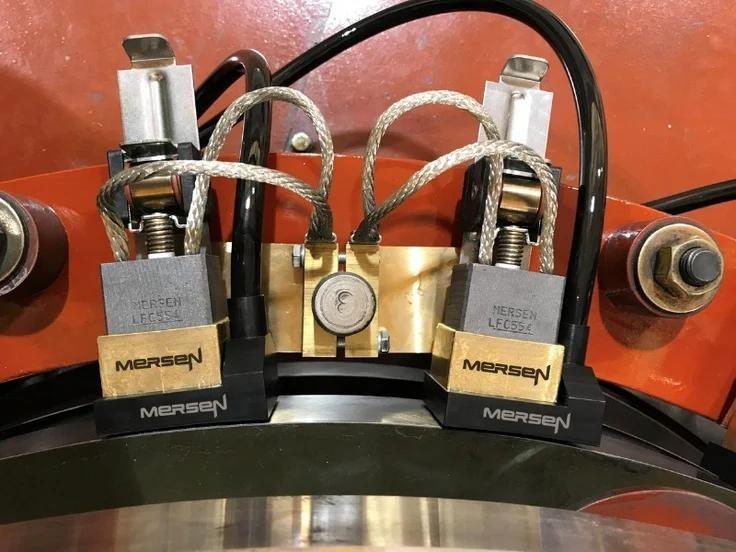
How to Replace Carbon Brushes: Step-by-Step Guide and When to Replace Them
Carbon brushes are essential components in many brushed electric motors, generators, and slip ring systems. They maintain electrical contact between stationary and rotating parts, allowing current to flow while the machine operates.
Over time, carbon brushes gradually wear down due to friction, electrical loading, mechanical contact, and operating conditions. If worn brushes are not replaced at the appropriate time, they can contribute to excessive sparking, unstable electrical contact, overheating, commutator or slip ring damage, and unexpected equipment downtime.
Knowing when to replace carbon brushes and how to install new ones correctly is therefore an important part of industrial motor and generator maintenance.
This guide explains the warning signs of carbon brush wear, how to determine when replacement is necessary, and the correct procedures for removing and installing carbon brushes. It also covers common replacement mistakes and practical recommendations for extending brush service life.
1. Why Do Carbon Brushes Need to Be Replaced?
Carbon brushes operate under continuous mechanical and electrical stress. During operation, each brush presses against a rotating commutator or slip ring while transmitting electrical current.
This sliding contact gradually removes material from the brush surface.
The rate of wear depends on several factors:
-
Motor or generator operating speed
-
Electrical current and current density
-
Carbon brush material and grade
-
Contact pressure from the brush spring
-
Commutator or slip ring surface condition
-
Operating temperature
-
Humidity, dust, and environmental contamination
-
Machine operating cycles and load variations
Carbon brushes are designed as consumable components. Their gradual wear is normal, but excessive or uneven wear may indicate an underlying problem with the electrical or mechanical system.
Replacing brushes at the correct time helps maintain stable electrical contact and reduces the risk of secondary damage to expensive rotating components.
2. When Should You Replace Carbon Brushes?
There is no single replacement interval that applies to every electric motor or generator. The correct replacement time depends on the equipment manufacturer's instructions, brush specifications, operating conditions, and actual wear measurements.
The following signs indicate that carbon brushes should be inspected and may need replacement.
2.1 Carbon Brushes Have Reached Their Minimum Permitted Length
This is one of the most important indicators.
As a carbon brush wears down, its remaining length becomes shorter. When it reaches the manufacturer's minimum permitted operating length, it should be replaced.
Do not wait until the brush is completely worn away.
Operating a brush below its permitted length can lead to poor contact, unstable spring pressure, damage to the flexible lead, or contact between the brush holder and the rotating surface.
The minimum permitted length is not universal. It must be determined from the equipment manual, brush drawing, or manufacturer's technical specification.
2.2 Excessive Sparking Around the Commutator or Slip Ring
Small, controlled electrical activity may occur in certain brushed systems, depending on their design and operating conditions. However, abnormal or excessive sparking requires investigation.
Possible causes include:
-
Carbon brushes that are excessively worn
-
Incorrect brush grade
-
Incorrect spring pressure
-
Poor brush seating
-
Uneven commutator or slip ring surfaces
-
Incorrect brush positioning
-
Electrical overload or current imbalance
-
Contamination on the contact surface
Replacing worn brushes may resolve the problem, but installing new brushes without identifying the original cause can result in repeated failures.
2.3 Cracked, Chipped, or Broken Carbon Brushes
Carbon brushes should be inspected for visible mechanical damage.
Common defects include:
-
Cracks across the brush body
-
Chipped edges
-
Broken corners
-
Damaged contact surfaces
-
Loose or damaged flexible leads
-
Separation around the terminal connection
A damaged brush should be evaluated for replacement. The cause of the damage should also be investigated, including vibration, improper installation, excessive mechanical pressure, or contact surface irregularities.
2.4 Uneven or Abnormal Brush Wear
Carbon brushes should wear in a manner consistent with their design and operating conditions.
If one brush wears significantly faster than other brushes in the same assembly, the problem may not be the carbon material itself.
Possible causes include:
-
Unequal spring pressure
-
Misaligned brush holders
-
Incorrect brush dimensions
-
Commutator or slip ring runout
-
Uneven current distribution
-
Surface contamination
-
Incorrect brush grade
Comparing brush lengths and wear patterns across multiple brush positions can help identify abnormal operating conditions.
2.5 The Flexible Lead or Terminal Is Damaged
The flexible copper lead carries current from the brush to its electrical connection.
Inspect the lead for:
-
Broken or exposed conductors
-
Overheating or discoloration
-
Loose terminal connections
-
Damaged insulation
-
Excessive bending or mechanical tension
A damaged flexible lead or terminal can cause electrical resistance, localized heating, and unstable current transmission.
Depending on the brush design, the complete brush assembly may need to be replaced rather than repairing the connection.
2.6 The Brush Is Sticking Inside the Brush Holder
A carbon brush must move freely within its holder so that the spring can maintain the required contact pressure.
If the brush becomes stuck, it may lose contact with the commutator or slip ring.
Possible reasons include:
-
Carbon dust accumulation
-
Corrosion inside the holder
-
Incorrect brush dimensions
-
Distorted brush holder walls
-
Mechanical damage
-
Excessive clearance or insufficient clearance
Before installing a replacement brush, inspect the holder and verify that the new brush has the correct dimensions and tolerances.
3. How to Replace Carbon Brushes: Step-by-Step Guide
Carbon brush replacement is a maintenance task that should be performed by qualified personnel familiar with the specific equipment.
The following procedure provides a general guide. Always follow the equipment manufacturer's maintenance instructions, electrical safety requirements, and approved work procedures.
Step 1: Disconnect and Secure the Equipment
Before starting any maintenance work:
-
Shut down the motor or generator according to the approved procedure.
-
Isolate all electrical power sources.
-
Apply lockout/tagout (LOTO) procedures.
-
Verify that the equipment is de-energized using an appropriate testing method.
-
Allow rotating components to stop completely.
-
Allow hot components to cool.
-
Discharge stored electrical energy where applicable.
Never remove or install carbon brushes on energized equipment unless a specific manufacturer-approved procedure explicitly requires a specialized live-maintenance operation performed by authorized personnel.
Step 2: Locate the Carbon Brush Assembly
Identify the carbon brush holders and their positions.
Depending on the machine design, brush assemblies may be installed around:
-
A motor commutator
-
A generator commutator
-
A slip ring assembly
-
A specialized electrical contact system
Before removing anything, record the original brush arrangement.
Useful information includes:
-
Brush position
-
Brush orientation
-
Brush dimensions
-
Lead direction
-
Terminal connection
-
Spring arrangement
-
Brush holder position
Taking photographs before disassembly can help prevent installation mistakes.
Step 3: Inspect the Existing Carbon Brushes
Remove the protective cover or access panel according to the equipment manual.
Inspect each brush before removal.
Check:
-
Remaining brush length
-
Contact surface condition
-
Wear pattern
-
Cracks and chips
-
Flexible lead condition
-
Terminal connections
-
Spring condition
-
Brush holder cleanliness
If multiple brushes are installed, compare their condition.
Recording the measurements of the old brushes can also help confirm the correct replacement specifications.
Step 4: Remove the Worn Carbon Brushes
Release the brush spring or retaining mechanism according to the equipment design.
Carefully remove the carbon brush from its holder.
If the brush has a flexible lead, disconnect its terminal using the appropriate method.
Avoid pulling the brush by its lead or applying excessive force.
If the brush is stuck, do not force it out. Inspect the holder for carbon dust, corrosion, deformation, or other obstructions.
Damaged brush holders should be repaired or replaced before installing new brushes.
Step 5: Clean and Inspect the Brush Holder
Before installing a replacement brush, check the complete brush holder assembly.
Important inspection points include:
-
Internal holder surfaces
-
Brush guide clearance
-
Spring condition
-
Spring pressure
-
Electrical connections
-
Insulation components
-
Holder alignment
-
Mounting hardware
Remove accumulated carbon dust using an approved industrial vacuum or the cleaning method specified by the equipment manufacturer.
Avoid uncontrolled compressed-air cleaning, which can spread conductive carbon dust into electrical components and surrounding equipment.
Do not apply oil, grease, or other lubricants inside the brush holder unless specifically permitted by the equipment manufacturer.
Step 6: Confirm the Replacement Brush Specifications
Selecting the correct replacement carbon brush is essential.
A brush that looks similar to the original may still have different electrical or mechanical properties.
Before installation, verify the following parameters:
| Parameter | What to Check |
|---|---|
| Width | Correct brush width |
| Thickness | Correct brush thickness |
| Length | Correct original or specified replacement length |
| Material grade | Suitable electrical and mechanical properties |
| Flexible lead | Correct length, cross-section, and configuration |
| Terminal | Correct connection type |
| Contact surface | Suitable for the commutator or slip ring |
| Design | Correct chamfer, groove, shape, or special features |
The carbon brush grade is particularly important.
Different grades have different electrical resistivity, hardness, friction characteristics, and wear behavior.
Using an unsuitable grade may cause excessive wear, sparking, commutator damage, or unstable electrical contact.
When the original grade is unknown, the equipment model, original brush markings, operating parameters, drawings, or a physical sample should be used to evaluate a suitable replacement.
Step 7: Install the New Carbon Brush
Carefully insert the new carbon brush into the holder.
Make sure that:
-
The brush fits correctly.
-
The brush moves freely within the holder.
-
The contact face is oriented correctly.
-
The flexible lead is not twisted or trapped.
-
The terminal is securely connected.
-
The spring is correctly positioned.
-
The brush is not mechanically damaged during installation.
The brush should move freely without excessive lateral movement.
Incorrect dimensions can cause the brush to stick or vibrate during operation.
Step 8: Check Spring Pressure
The brush spring provides the force needed to maintain contact between the carbon brush and the rotating surface.
Insufficient pressure can cause intermittent contact and electrical sparking.
Excessive pressure can increase friction, temperature, and mechanical wear.
Spring pressure should be checked against the equipment manufacturer's specified value using an appropriate measuring method.
Do not assume that a new brush will work correctly simply because it fits inside the holder.
Step 9: Check Brush Seating and Contact Surface
The contact face of the carbon brush must make suitable contact with the commutator or slip ring.
Depending on the brush design and manufacturer's instructions, a bedding-in or seating procedure may be required.
Some brushes are supplied with preformed contact surfaces, while others may require a specified seating process.
Where bedding is required, use only the approved method and suitable materials.
Do not use an unsuitable abrasive material or modify the brush contact surface without confirming the manufacturer's requirements.
Step 10: Complete the Final Inspection
Before returning the equipment to service, check:
-
All brush holders are securely installed.
-
All electrical connections are correctly tightened.
-
Flexible leads are correctly positioned.
-
Springs are correctly installed.
-
Brushes move freely.
-
Protective covers are reinstalled.
-
No tools or foreign objects remain inside the equipment.
-
All maintenance work is completed according to the approved procedure.
After maintenance personnel have cleared the equipment and the appropriate authorization has been obtained, the machine can be returned to service following its normal commissioning or restart procedure.
Monitor the equipment according to the manufacturer's instructions and check for abnormal sparking, unusual noise, overheating, or unstable operation.
4. What Happens If You Replace Carbon Brushes Too Late?
Delaying carbon brush replacement can lead to problems beyond the cost of the brushes themselves.
4.1 Damage to the Commutator or Slip Ring
When a brush wears beyond its permitted limit, the brush holder or other components may contact the rotating surface.
This can damage the commutator or slip ring and increase repair costs.
4.2 Unstable Electrical Contact
An excessively worn brush may not maintain consistent contact pressure.
This can cause intermittent electrical transmission, unstable operation, and increased sparking.
4.3 Increased Operating Temperature
Poor electrical contact and abnormal friction can contribute to localized heating.
Excessive temperature may damage nearby insulation, terminals, brush holders, or other electrical components.
4.4 Unexpected Equipment Downtime
For industrial motors, generators, cranes, mining equipment, and other continuous-duty machinery, unexpected brush failure can interrupt production.
Regular inspection and timely replacement help reduce the likelihood of unplanned maintenance.
5. Common Mistakes During Carbon Brush Replacement
Even when replacement brushes are available, incorrect installation can create additional problems.
Mistake 1: Choosing a Brush Only by Its Dimensions
Two carbon brushes with identical dimensions may have very different electrical and mechanical properties.
Always verify the material grade and operating suitability, not just the physical size.
Mistake 2: Mixing Different Carbon Brush Grades
Using different grades in the same brush assembly may create uneven electrical and mechanical behavior.
Unless specifically approved by the equipment manufacturer or a qualified engineering assessment, replacement brushes should follow the original specified grade and configuration.
Mistake 3: Ignoring the Brush Holder
Installing new brushes without checking the holder can lead to repeated failures.
A worn, damaged, dirty, or misaligned holder may prevent correct brush movement and contact pressure.
Mistake 4: Ignoring Spring Pressure
Incorrect spring pressure can affect contact stability, brush wear, and operating temperature.
Always inspect the spring system during replacement.
Mistake 5: Replacing Brushes Without Investigating Abnormal Wear
If the original brushes show excessive wear, cracking, overheating, or unusual sparking, simply installing new brushes may not solve the problem.
The entire brush contact system should be inspected.
6. How Often Should Carbon Brushes Be Replaced?
There is no universal replacement schedule for all carbon brushes.
Some machines operate continuously under demanding conditions, while others operate intermittently or under relatively light loads.
The most reliable approach is condition-based maintenance supported by the manufacturer's recommended inspection schedule.
A practical maintenance program should include:
Routine visual inspection
Check for visible damage, abnormal sparking, dust accumulation, and unusual operating conditions.
Wear measurement
Measure brush length and compare it with the manufacturer's minimum permitted length.
Spring and holder inspection
Verify that brushes move freely and that spring pressure remains within the specified range.
Contact surface inspection
Check the commutator or slip ring for abnormal wear, contamination, grooves, discoloration, or other damage.
Maintenance records
Record brush dimensions, wear measurements, operating hours where available, replacement dates, and observed problems.
These records help maintenance teams identify changes in wear patterns and plan future replacement work.
7. How to Choose the Right Replacement Carbon Brushes
When ordering replacement carbon brushes, providing accurate technical information helps reduce selection errors and unnecessary downtime.
The following information is useful:
-
Original carbon brush part number
-
Equipment manufacturer and model
-
Brush width, thickness, and length
-
Original material grade
-
Flexible lead length and configuration
-
Terminal type
-
Operating voltage and current, where available
-
Motor or generator application
-
Original drawings or photographs
-
Physical samples, if available
If the original brush grade or part number is unavailable, a technical evaluation may be necessary before selecting a replacement.
For customized carbon brushes, drawings and physical samples are particularly useful because they allow the dimensions, lead configuration, terminal design, and contact geometry to be checked.
8. Can Carbon Brushes Be Replaced with Customized Alternatives?
In many industrial applications, replacement carbon brushes can be evaluated and manufactured according to original drawings, physical samples, or confirmed technical specifications.
However, a customized replacement should not be selected based on appearance alone.
A suitable replacement needs to consider:
-
Electrical conductivity and resistivity
-
Mechanical strength
-
Hardness
-
Friction characteristics
-
Wear behavior
-
Current density
-
Operating speed
-
Contact surface material
-
Working temperature
-
Brush holder dimensions
-
Spring pressure and installation configuration
The final material selection should be based on the actual equipment requirements and, where necessary, testing or engineering validation.
VOCARBON provides carbon brush and related electrical contact component sourcing and customized replacement evaluation based on customer drawings, samples, and technical requirements.
Whether you need a standard carbon brush, a brush with a flexible lead, a special terminal configuration, or a replacement for an existing industrial application, providing the original part number or technical information is the best starting point.
9. Carbon Brush Replacement Checklist
Use the following checklist as a practical reference during maintenance planning.
Before replacement
-
Confirm the equipment model and brush specifications.
-
Review the manufacturer's maintenance instructions.
-
Isolate the equipment and complete LOTO procedures.
-
Record the original brush positions and configurations.
-
Measure and inspect the existing brushes.
During replacement
-
Remove worn brushes carefully.
-
Inspect and clean the brush holders.
-
Check springs and electrical connections.
-
Verify replacement brush dimensions and material grade.
-
Install the brushes in the correct orientation.
-
Confirm free movement and correct spring pressure.
After replacement
-
Complete the final mechanical and electrical inspection.
-
Confirm that all protective covers are installed.
-
Follow the approved restart procedure.
-
Monitor operation for abnormal sparking, noise, or overheating.
-
Record the replacement details for future maintenance.
10. Conclusion: Replace Carbon Brushes at the Right Time
Carbon brush replacement is an important part of maintaining brushed electric motors, generators, and slip ring systems.
The best time to replace a carbon brush is not necessarily when it has completely worn out. Instead, replacement should be based on the manufacturer's minimum permitted brush length, actual wear condition, electrical performance, and the condition of the complete brush assembly.
Correct replacement involves more than removing an old brush and inserting a new one. Brush grade, dimensions, spring pressure, holder condition, contact surface quality, and installation accuracy all affect long-term performance.
By combining regular inspection with correct material selection and installation procedures, maintenance teams can improve electrical contact reliability, reduce avoidable component damage, and support more predictable equipment maintenance.
Looking for replacement carbon brushes or customized carbon brush assemblies?
VOCARBON supports industrial customers with carbon brushes, carbon brush holders, slip ring components, and replacement solutions evaluated according to customer drawings, samples, and technical specifications.
Contact our team to discuss your application or submit your requirements.
Website: https://www.vocarbon.com/
Email: sales@vocarbon.com