
What Is the Function of a Carbon Brush? Working Principle, Applications, and Benefits
Carbon brushes are essential electrical contact components used in many brushed electric motors, generators, and slip ring systems. Although they are relatively small components, they perform an important function: transmitting electrical current between stationary and rotating parts while maintaining continuous sliding contact.
Without properly functioning carbon brushes, many brushed electrical machines cannot operate reliably. Poor electrical contact can lead to excessive sparking, unstable current transmission, overheating, and damage to other components.
But what exactly does a carbon brush do? Why is carbon used instead of ordinary metal? How does a carbon brush work inside an electric motor or generator? And where are carbon brushes commonly used?
This article explains the function of carbon brushes, their working principles, different applications, material types, and maintenance requirements.
1. What Is a Carbon Brush?
A carbon brush is an electrical contact component generally manufactured from carbon, graphite, or specially formulated carbon-based materials.
It is designed to maintain electrical contact between a stationary electrical circuit and a rotating component.
In many electric motors, the brush makes contact with a rotating commutator. In certain generators and slip ring systems, it contacts a rotating slip ring.
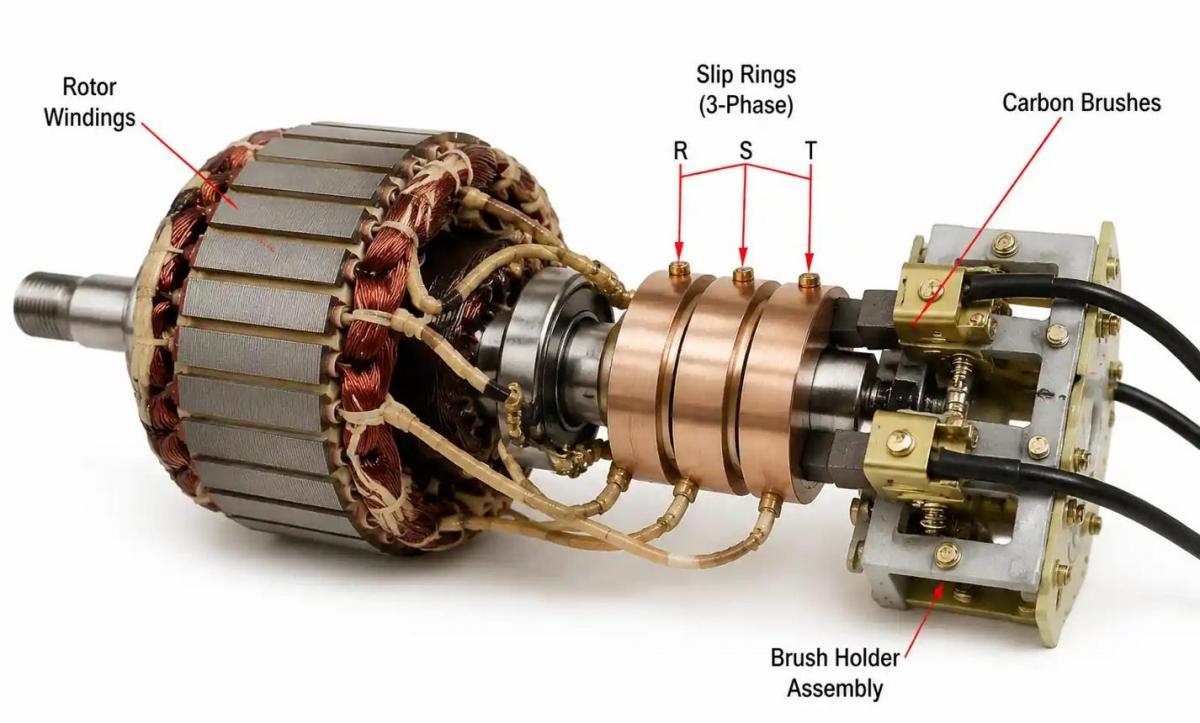
A typical carbon brush assembly consists of several components:
-
Carbon Brush: The main conductive contact element.
-
Brush Holder: Holds the carbon brush in the correct position.
-
Spring: Applies controlled pressure to maintain contact with the rotating surface.
-
Flexible Lead: Connects the brush electrically to the external circuit.
-
Terminal: Provides the electrical connection to the machine.
The carbon brush gradually wears during operation because it continuously slides against the rotating contact surface. It is therefore considered a consumable maintenance component.
Carbon brushes are available in different shapes, sizes, material grades, and connection configurations to meet the requirements of different electrical machines.
2. What Is the Main Function of a Carbon Brush?
The primary function of a carbon brush is to transfer electrical current between stationary and rotating parts of an electrical machine.
However, its role involves several related functions.
2.1 Transmitting Electrical Current
The most important function of a carbon brush is electrical current transmission.
In a brushed DC motor, current must be supplied to the rotating armature. Carbon brushes contact the commutator, allowing current to flow from the stationary power supply into the rotating winding circuit.
In a generator with a brushed excitation system, carbon brushes can transfer excitation current to the rotating field winding through slip rings.
In these applications, the brush provides a sliding electrical connection without requiring a fixed wire connection directly to the rotating component.
2.2 Maintaining Continuous Electrical Contact
Rotating components cannot normally be connected to stationary electrical wiring using ordinary fixed connections.
Carbon brushes solve this problem by maintaining sliding contact with a rotating conductive surface.
A spring inside the brush holder applies controlled pressure to keep the brush in contact with the commutator or slip ring.
This arrangement allows electrical current to pass while the rotating component continues moving.
2.3 Supporting Current Commutation in Brushed DC Motors
In a conventional brushed DC motor, carbon brushes work together with the commutator.
The commutator is a segmented conductive component connected to the armature windings.
As the armature rotates, the commutator segments pass under the stationary brushes. The electrical connections to the armature windings are switched in the appropriate sequence.
This process is called commutation.
Commutation helps maintain torque in the required direction during continuous rotation.
The carbon brushes provide the electrical contact needed for this process, while the commutator performs the mechanical switching of the armature connections.
2.4 Transferring Excitation Current in Generators
In certain generators, carbon brushes transfer electrical current to the rotating field winding through slip rings.
This current creates the magnetic field required for generator operation.
The brushes maintain contact with the rotating slip rings while the generator shaft turns.
It is important to distinguish brushed excitation systems from brushless generator designs. Many modern industrial generators use brushless excitation systems and do not require conventional carbon brushes for field-current transfer.
2.5 Supporting Reliable Electrical Operation
Carbon brushes are designed to provide a suitable balance between electrical conductivity, mechanical strength, friction, and wear characteristics.
A properly selected brush grade can help maintain stable contact and reduce unnecessary wear on the rotating contact surface.
However, performance depends on the complete electrical contact system, including the brush material, spring pressure, brush holder, commutator or slip ring condition, and operating environment.
3. How Does a Carbon Brush Work?
The working principle of a carbon brush is based on sliding electrical contact.
Although the exact arrangement depends on the machine design, the basic process is relatively straightforward.
Step 1: The Carbon Brush Is Installed in a Brush Holder
The carbon brush is inserted into a holder mounted on the stationary part of the electrical machine.
The holder keeps the brush aligned with the rotating contact surface.
Step 2: The Spring Applies Contact Pressure
A spring presses the brush against the commutator or slip ring.
This pressure helps maintain electrical contact as the rotating surface moves.
The spring must provide the correct force. Too little pressure may cause intermittent contact, while excessive pressure can increase friction and wear.
Step 3: The Rotating Surface Moves Under the Brush
When the motor or generator operates, the commutator or slip ring rotates beneath the stationary carbon brush.
The brush slides along the conductive surface while remaining electrically connected to the external circuit.
Step 4: Electrical Current Passes Through the Contact
Current flows through the flexible lead, carbon brush, and rotating conductive surface, or in the reverse direction depending on the machine's electrical configuration.
This arrangement enables electrical energy to be transferred between stationary and rotating components.
Step 5: The Brush Gradually Wears
Because the carbon brush remains in sliding contact with the rotating surface, gradual wear occurs.
The brush is designed to be replaceable so that the electrical contact system can continue operating without requiring replacement of the entire machine.
4. What Is the Function of a Carbon Brush in an Electric Motor?
Carbon brushes are used in many brushed electric motors.
Their exact function depends on the motor type.
4.1 DC Motors
In conventional brushed DC motors, carbon brushes supply current to the rotating armature through the commutator.
The commutator changes the electrical connections to the armature windings as the rotor turns.
The combined operation of the brushes and commutator allows the motor to produce continuous rotational torque.
Applications include:
-
Industrial DC motors
-
Electric hoists
-
Cranes
-
Material handling equipment
-
Certain traction motors
-
Selected machine tools
4.2 Universal Motors
Universal motors can operate on AC or DC power.
Carbon brushes maintain electrical contact with the commutator and supply current to the rotating armature.
They are commonly found in selected applications requiring compact motors and high rotational speeds.
Examples include certain power tools, portable equipment, and household appliances.
4.3 Slip Ring Induction Motors
In wound-rotor induction motors, slip rings and carbon brushes connect the rotating rotor winding circuit to external electrical components.
This arrangement can be used for starting and speed-control functions in certain motor designs.
The brushes provide the electrical connection between the rotating rotor circuit and stationary external equipment.
Not all induction motors use brushes. Standard squirrel-cage induction motors do not require conventional carbon brushes.
4.4 Brushless Motors
Brushless DC motors and many modern permanent-magnet motors use electronic commutation rather than conventional mechanical brush-and-commutator systems.
They do not require traditional carbon brushes for rotor current transmission.
Understanding this distinction is important when selecting replacement parts for industrial motors.
5. What Is the Function of a Carbon Brush in a Generator?
In generators, carbon brushes are commonly associated with electrical connections to rotating components.
However, their specific role depends on the generator's design.
5.1 Field Current Transfer
In certain brushed generators, carbon brushes transfer excitation current through slip rings to the rotating field winding.
The field winding produces the magnetic field needed for electromagnetic induction.
This allows the generator to produce electrical output.
5.2 Electrical Connection to Rotating Circuits
Some electrical machines use brushes to transfer current from rotating circuits to stationary circuits.
The direction of current transfer depends on the design and operating principle of the machine.
5.3 Generator Maintenance
Because carbon brushes are consumable components, they require regular inspection.
Maintenance personnel should monitor:
-
Remaining brush length
-
Contact surface condition
-
Spring pressure
-
Brush holder clearance
-
Slip ring condition
-
Electrical connections
-
Abnormal sparking
-
Operating temperature
Worn brushes should be replaced according to the manufacturer's requirements.
Some generators use brushless excitation systems, so it is necessary to confirm the generator configuration before ordering replacement carbon brushes.
6. What Is the Function of Carbon Brushes in Slip Ring Systems?
A slip ring system provides an electrical connection between stationary and rotating components.
Carbon brushes are frequently used as the stationary electrical contacts that slide against the rotating rings.
The main functions include:
-
Transmitting electrical current across a rotating interface.
-
Maintaining continuous contact during rotation.
-
Supporting power transfer to or from rotating equipment.
-
Supporting signal transmission in certain specially designed systems.
Slip ring brush applications can be found in:
-
Industrial rotating machinery
-
Wind turbine electrical systems
-
Cranes and hoisting equipment
-
Cable reels
-
Rotating electrical equipment
-
Selected generators and motors
The brush material must be compatible with the slip ring material, current requirements, rotational speed, and environmental conditions.
Incorrect material selection can contribute to excessive wear, sparking, and damage to the contact surface.
7. Why Are Carbon Brushes Made from Carbon Instead of Ordinary Metal?
Carbon and graphite are widely used for electrical sliding contacts because they offer a useful combination of electrical, mechanical, and tribological properties.
7.1 Electrical Conductivity
Carbon brush materials can conduct electricity while providing controlled electrical resistance.
Different grades are formulated for different current and operating requirements.
7.2 Self-Lubricating Characteristics
Graphite has a layered crystal structure that contributes to its lubricating behavior.
This can help reduce friction at the sliding contact interface under suitable operating conditions.
7.3 Controlled Wear
Carbon brush materials are designed to wear gradually under normal operating conditions.
The brush acts as a replaceable contact component, helping protect the more expensive commutator or slip ring.
7.4 Thermal Performance
Carbon and graphite materials can provide useful thermal properties in electrical contact applications.
The actual performance depends on material composition, grade, operating temperature, and machine design.
7.5 Material Flexibility
Carbon brush manufacturers can formulate different material grades to meet different requirements.
For example, a brush used in a small DC motor may require different electrical and mechanical properties from a brush used in a large industrial generator.
8. Different Types of Carbon Brush Materials
Not all carbon brushes have the same material composition.
Different material families are selected according to electrical loading, rotational speed, mechanical conditions, and the characteristics of the contact surface.
8.1 Electrographite Carbon Brushes
Electrographite brushes are produced using carbon materials subjected to high-temperature graphitization processes.
They are used in various industrial motors and generators where their electrical and mechanical properties are suitable.
8.2 Resin-Bonded Carbon Brushes
Resin-bonded brushes use a binding system to combine carbon-based materials.
Their properties depend on the formulation and manufacturing process.
They are used in selected motor and electrical contact applications.
8.3 Metal-Graphite Carbon Brushes
Metal-graphite brushes contain graphite combined with metallic materials, commonly copper or silver.
They are designed for applications requiring specific electrical conductivity and contact characteristics.
8.4 Copper-Graphite Carbon Brushes
Copper-graphite brushes are commonly used in selected low-voltage, high-current applications.
Their suitability depends on current density, rotational speed, contact surface, and machine requirements.
8.5 Natural Graphite Carbon Brushes
Natural graphite-based materials are used in certain electrical contact applications where their properties meet the operating requirements.
The appropriate grade must be selected according to the machine specifications.
Important: These are material categories, not universal performance grades. Specific carbon brush grades and their technical properties vary among manufacturers. A material should not be selected based on its category alone.
9. Where Are Carbon Brushes Used?
Carbon brushes are used in a wide range of industries where brushed electrical machines or slip ring systems are required.
<IMAGE_PLACEHOLDER>
9.1 Industrial Motors
Carbon brushes are used in selected brushed DC motors and other motor designs requiring sliding electrical contacts.
Typical applications include cranes, hoists, material handling systems, and industrial machinery.
9.2 Power Generation
Certain generators use carbon brushes to transfer excitation current or connect rotating electrical circuits.
Brush maintenance is important for reliable operation in these systems.
9.3 Wind Energy
Some wind turbine designs use slip rings and carbon brushes for electrical power or signal transfer across rotating interfaces.
The exact brush arrangement depends on the turbine architecture.
9.4 Railway and Traction Systems
Carbon brushes are used in selected railway traction motors and auxiliary electrical equipment.
They help maintain electrical contact in rotating electrical machines operating under demanding mechanical conditions.
9.5 Mining and Heavy Equipment
Certain mining machines, hoists, cranes, and heavy industrial systems use brushed motors or slip ring assemblies.
These applications may require specially selected brush grades to handle their electrical and mechanical operating conditions.
9.6 Automotive Electrical Systems
Carbon brushes are used in selected automotive electrical components, including certain starter motors and alternators.
However, many modern automotive motors, including most electric vehicle traction motors, use brushless designs.
10. What Happens When a Carbon Brush Fails?
A carbon brush that is excessively worn, damaged, or incorrectly selected can affect the performance of the entire electrical contact system.
Common warning signs include:
-
Excessive sparking
-
Unstable electrical contact
-
Reduced motor performance
-
Abnormal heating
-
Uneven brush wear
-
Cracked or chipped brushes
-
Damaged flexible leads
-
Poor contact with the commutator or slip ring
These symptoms do not necessarily mean that the carbon brush itself is the only problem.
The brush holder, spring pressure, electrical load, contact surface condition, and operating environment should also be inspected.
Replacing a worn brush without investigating the underlying cause may lead to repeated failures.
11. How to Select the Right Carbon Brush
Choosing the correct carbon brush is important for electrical performance and equipment reliability.
Before selecting a replacement, consider the following parameters:
| Selection Parameter | Why It Matters |
|---|---|
| Brush dimensions | Ensures correct fit inside the holder |
| Material grade | Determines electrical and mechanical behavior |
| Electrical resistivity | Influences current transmission characteristics |
| Hardness | Affects mechanical wear behavior |
| Current density | Helps determine electrical loading suitability |
| Rotational speed | Influences friction and wear conditions |
| Spring pressure | Maintains correct contact force |
| Contact surface material | Affects compatibility and wear |
| Flexible lead | Ensures suitable electrical connection |
| Operating environment | Influences material and design requirements |
For replacement applications, the original part number, equipment model, technical drawing, or physical sample is particularly useful.
Two carbon brushes may have identical dimensions but different material properties. Therefore, physical similarity alone does not guarantee interchangeability.
12. How to Extend Carbon Brush Service Life
Although carbon brushes are designed to wear, proper maintenance can help prevent unnecessary damage and improve operating reliability.
Recommended practices include:
Use the correct carbon brush grade.
Select a material suitable for the machine's electrical and mechanical requirements.
Maintain correct spring pressure.
Inspect brush springs and verify that contact pressure follows the equipment manufacturer's specifications.
Keep brush holders clean.
Accumulated carbon dust can interfere with brush movement and electrical connections.
Inspect the commutator or slip ring.
Check for abnormal wear, contamination, grooves, and surface damage.
Replace brushes before reaching the minimum permitted length.
Follow the equipment manufacturer's replacement criteria rather than waiting for complete brush failure.
Monitor abnormal sparking and heating.
Investigate unusual operating conditions instead of treating every problem as normal brush wear.
For additional maintenance information, refer to the equipment manufacturer's instructions and a dedicated carbon brush maintenance procedure.
13. Conclusion: Small Component, Essential Electrical Function
Carbon brushes are relatively small components, but they perform an important role in many brushed electric motors, generators, and slip ring systems.
Their main function is to transfer electrical current between stationary and rotating parts while maintaining sliding electrical contact.
In brushed DC motors, they work together with the commutator to supply current to the rotating armature. In certain generators, they transfer excitation current through slip rings. In other rotating electrical systems, they provide a reliable electrical contact across a rotating interface.
The performance of a carbon brush depends on more than its dimensions. Material grade, electrical characteristics, mechanical strength, spring pressure, brush holder design, and contact surface condition all influence its operating behavior.
Selecting the correct brush and maintaining the complete contact system are essential for reliable equipment operation.
Looking for industrial carbon brushes or customized replacement solutions?
VOCARBON supports industrial customers with carbon brushes, carbon brush holders, slip ring components, and replacement solutions evaluated according to customer drawings, physical samples, and technical specifications.
Whether you need a standard carbon brush or a specially configured replacement for an industrial motor or generator, our team can help evaluate your requirements.
Visit: https://www.vocarbon.com/
Email: sales@vocarbon.com