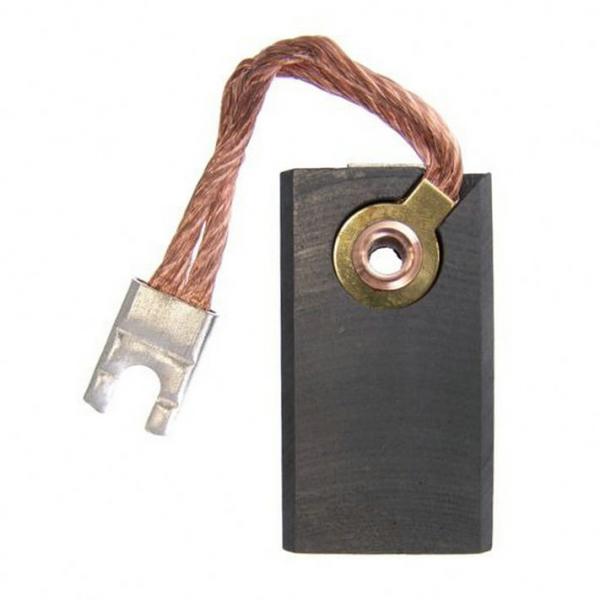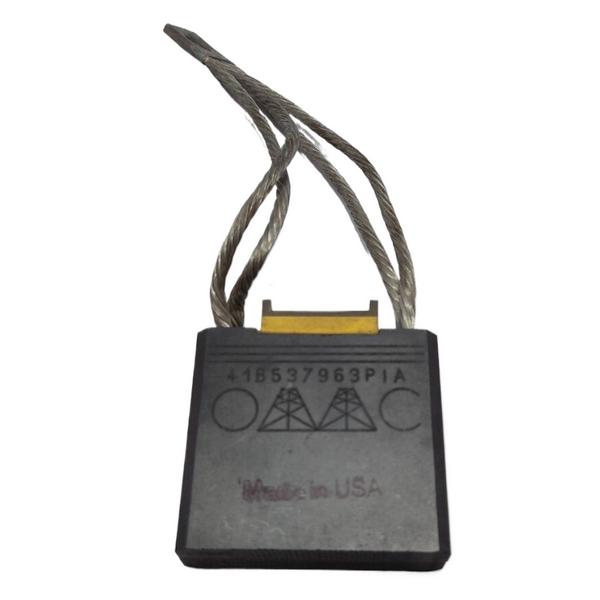
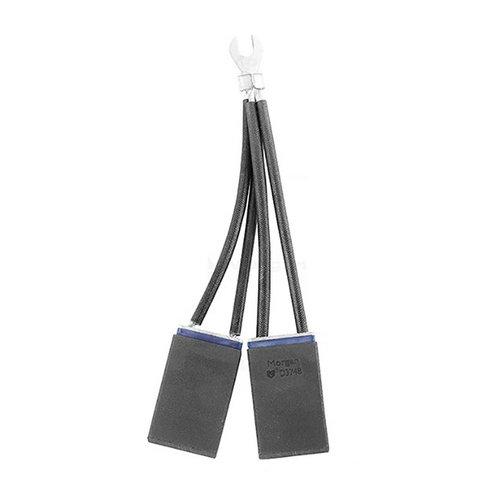
This D374B / D374N carbon brush is an electrographite (baked carbon-graphite) brush from the D374 family, used on railway traction motors — including GE locomotive traction motors — as well as locomotive main generators, turbine-generator exciter motors, rolling-mill motors and Z4 series DC motors. D374B is the railway/GE-motor variant, typically supplied as a 2 × (11 × 36 × 44) mm split (double) brush with double copper-braid shunts. D374N is the carbon-black-based electrographite variant characterised by a porous structure, high commutation capability and good commutation performance, intended for high-speed traction DC motors with difficult commutation; per JB/T 4003-2001 data it has resistivity 58 µΩ·m ±30%, Rockwell hardness 83 (10 mm ball) +20%/−35%, density 1.57 g/cm³, a pair contact drop of 2.8 V ±35%, 50 h wear ≤0.15 mm, rated current density 12 A/cm², permissible peripheral speed 60 m/s and recommended brush pressure 19,600–39,200 Pa. The sibling grade D374 (non-N) is softer and more conductive — resistivity 44 µΩ·m ±30%, Rockwell 70, density 1.56 g/cm³ — so the two are not interchangeable without checking commutation behaviour. Brushes are manufactured to your required size and lead arrangement (D374N common sizes 12.5 × 25 × 40, 16 × 25 × 40, 20 × 25 × 40, 20 × 32 × 40, 16 × 32 × 50 mm; D374B 2 × 11 × 36 × 44 mm; custom per drawing).
Features & benefits:
- D374B railway variant — GE traction motors, locomotive main generators, AC/DC machines
- D374N high-commutation variant — porous carbon-black electrographite, good commutation on difficult high-speed traction motors
- JB/T 4003-2001 data: ρ58 µΩ·m, Rockwell 83, 12 A/cm², 60 m/s, wear ≤0.15 mm/50 h
- Split-brush option — 2 × (11 × 36 × 44) mm with double shunt for traction service
- Custom to your drawing — sizes, lead length and terminal per specification
- Quality-inspected before dispatch: dimensional check, lead crimp integrity, and surface condition per batch